
-
Bus, Private Vehicle, Mountain Bike
-
3 Stars Hotels
-
5,895 metres
-
Moshi/Tanzania
-
June to December
-
Eco-Tour, Hiking
-
All meals during the trek
-
English, Spanish, French, Chinese
-
Extreme Hard
-
1-200
-
12
-
65
Overview
Whether you actually reach the summit depends almost exclusively upon one factor: Your acclimatization. Our whole itinerary is geared towards one single day, that is to say, summit day.
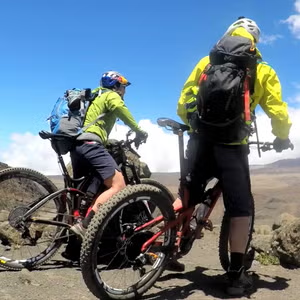
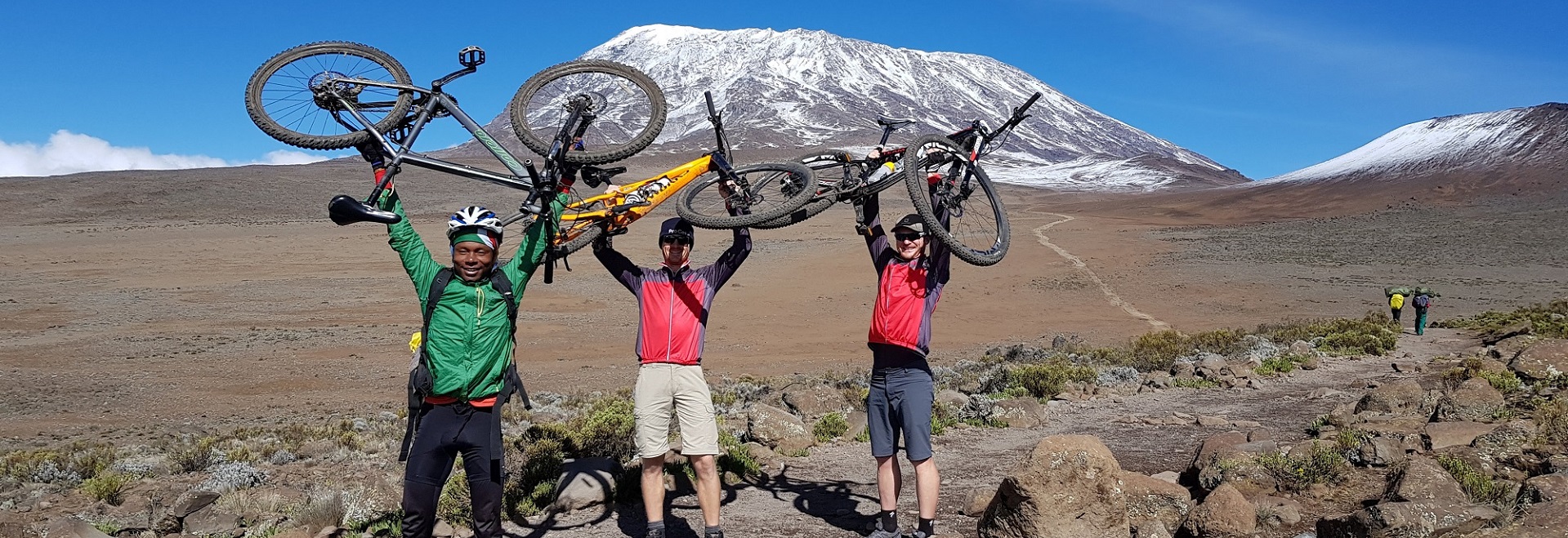
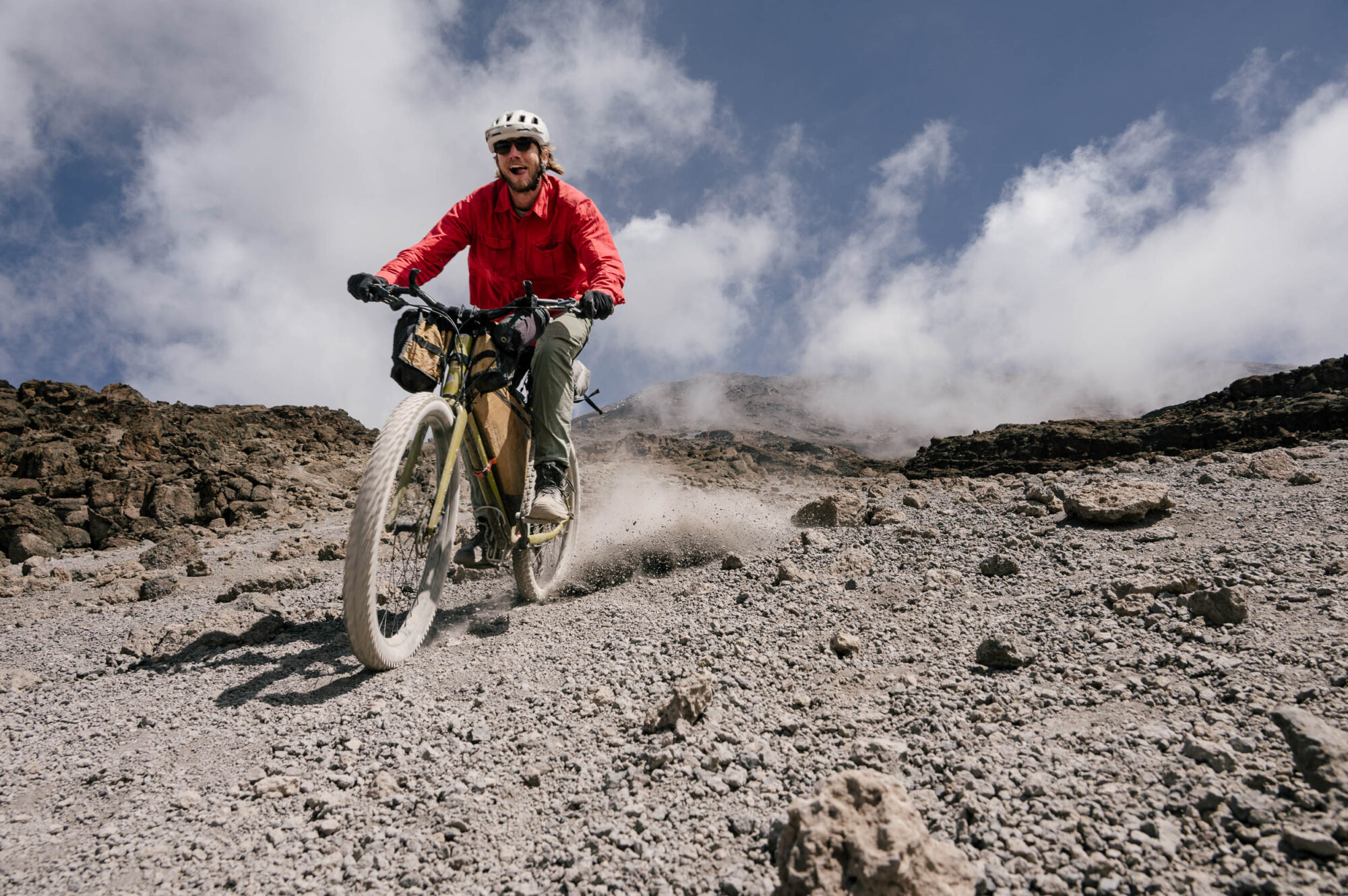
A lot of the time we will have to push the bikes. Riding them would theoretically be possible but it would use far too much energy. We need to save most of this for the day of the summit…when we will have a climb of 1200m. There is more than enough time for this, as we will set off shortly after midnight. As a reward for reaching the summit we have a compulsory souvenir photo in store for you as well as a nearly 5000m descent. You’re guaranteed to be talking about this for a long time afterwards.
The Kilema Mountain bike trail runs parallel with the Marangu route. The Kilema route is mainly used as an access road by vehicles to bring supplies to the Horombo hut and to evacuate medical emergencies from Horombo hut. The route from Kilema gate to Horombo hut is a 4 x 4 gravel road, which is usually in a fair condition.
The Kilema route with first night at the Kilema camp option, is shorter, less strenuous and involves more mountain biking, compared to the Kilema route option with the first night at Mandara hut. However it is more expensive, as the first night is spend camping in tents and the rest of the nights are spend in the Marangu route’s A-frame huts.
Trek Highlights
- Arrival
- Day 1: Kilema Gate (1950m) – Horombo hut (3705m)
- Day 2: Kilema Camp (2950m) – Horombo Hut (3705m)
- Day 3: (Acclimatisation Day – Cycle High and Sleep Low)
- Day 4: Horombo hut (3705m) – Kibo hut (4730m)
- Day 5: The summit night: Kibo hut (4730m) – Uhuru Peak (5895m) – Kibo hut (4730m)
- End
Itinerary
Upon arrival, you will meet and picked at Kilimanjaro International Airport with a KiliTwende Adventures representative followed by transferred to a hotel in Moshi, where you will meet with a Kilimanjaro Trekking guide for the Pre trekking briefing and equipment check up, then rest until the next morning for the starting trek.
Cycling time: Approximately 5 to 6 hours
Distance: Approximately 16 km
Habitat: Montane forest
Horombo hut (3705m) – Kilema camp (2950m)
Cycling time: 30 minutes
Distance: Approximately 7 km
Habitat: Moorland
Meet your guide and embark on your transfer to the Marangu gate, which takes about 45 minutes. The journey passes through the village of Marangu, which is located on the lower slopes of the mountain. Once you reach the park gate, all hikers are required to register at the Park office. After signing-in and registering at the Marangu gate, we drive to the Kilema gate.
Upon arrival you will ensure that you have all your daypack items (containing at least drinking water, your lunch pack and extra clothing) and do a final check on your mountain bike. You will then start the first route section of 16km, (with your guide also on a mountain bike) from the Kilema gate (1 950m) to the Horombo hut (3 705m) on a 4×4 track. Bikers with good fitness levels, mountain biking skills and subject to road conditions, will be able to cycle all the way to Horombo hut.
It is important to remember that the biggest cause of altitude sickness is ascending too high too quickly. We will be stopping regularly and to give your body the maximum time to adjust to the higher altitudes. We will aim to reach Horombo hut at around 15:00pm.
We will stop at Horombo Hut for a short break, before commencing on a downhill cycle to Kilema camp. Descending approximately 800m over 7km, the track has a lot of loose rocks and it is important to control your speed and avoid unnecessary risks!
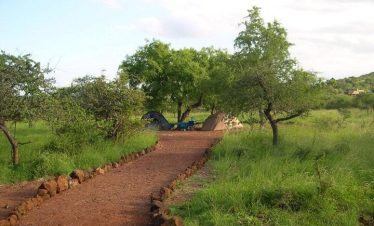
Upon arrival your porters will have your tent set up at camp and in the evening bring a small bowl of washing water to your tent. The cook will prepare dinner, before you retire to your tent for the night. Night temperatures can already drop to freezing point at this camp.
Cycling time: 2 to 3 hours
Distance: Approximately 7 km
Habitat: Moorland
Horombo hut (3705m) – Zebra Rocks (4 040m) – Horombo hut
Cycling time: 1 hour up and 20 minutes down
Distance: Approximately 2 km up and 2 km down
Habitat: Moorland
After breakfast, make sure your duffel bag are packed and we cycle from the Kilema camp to Horombo hut. The trail is steep and has a lots of loose rocks at certain areas. Horombo hut is a village of huts perched on a small plateau, with a total capacity of 120 climbers! Normally bustling with hikers, guides, porters and with an atmosphere of adventure and excitement. You will meet both ascending and descending hikers here.
We arrive in time for a late lunch at Horombo hut. After lunch collect our bikes and go for an 1,5 hour acclimatization cycle up to Zebra rocks (4 040m) and back.
Enjoy dinner and overnight at Horombo hut.
Horombo hut (3 705m) – Kibo hut (4 730m) – Horombo hut (3 705m)
Cycling time: 4 to 5 hours up and 1 hour down
Distance: 9.6 km up and 9.6km down
Habitat: Alpine desert
After an early breakfast, meet your guide and start your ascent into the Alpine desert habitat. The first 3 km of the trail is very rocky and cycling will be very difficult as this section is very stony and eroded. You will be forced to push and carry your bike for some sections, but after about 3km the trail improves and cycling will once again be possible.
The “Saddle” (which refers to the area located between the peaks of Mawenzi and Kibo) is relatively flat and cycling is much easier. However high altitudes, low oxygen levels and cold conditions make the 7km section towards Kibo hut strenuous and challenging.
The final km before reaching Kibo hut is especially strenuous. You will once again be reminded to slow down and drink enough water! Upon arrival to at Kibo hut lunch will be served.
After lunch we will embark on an awesome Kilimanjaro Mtb downhill, descending nearly 800m over 7km. The final 3km descend down to Horombo hut is very technical and challenging.
Dinner and overnight at Horombo hut.
Cycling time: 4 to 5 hours
Distance: Approximately 9.6 km
Habitat: Alpine desert
Early wake and make sure your duffel bags are packed and ready to go. After breakfast, meet your guide and we head back up to Kibo hut. Again the first 3km would require you pushing and carrying your bike a lot, with the final 7km to Kibo hut offering a good biking trail.
We will enjoy lunch and then aim to rest. At around 16h00 depending on how you feel it is possible to hike partially up the summit path to orientate yourself for the summit attempt later that night.
Situated in the barren Alpine desert is Kibo hut, a stone build block house which has bunk beds for 60 climbers, but no streams with water nearby. There are platform toilets behind the hut.
The summit (Uhuru Peak) is now a further 1195m up and you will make your final ascent the same night. Prepare your equipment, thermal clothing etc for your summit bid. This should include the replacement of your headlamp and camera batteries and make sure you have a spare set available as well. To prevent freezing it will be wise to carry your water in a thermal flask.
Cycling time: 7 to 8 hours to reach Uhuru Peak, 3 to 4 hours to descend to Kibo hut,
Distance: Approximately 5.4km ascent and 31 km descent
Habitat: Stone scree and ice-capped summit
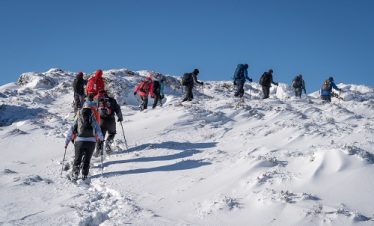
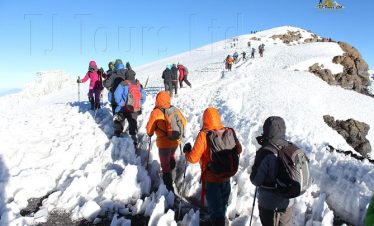
You will rise around 22h00, and after some tea and biscuits you shuffle off into the night, and this is where the going really gets tough. The first section of the trail consists of a rocky path to the Hans Meyer Cave (5150m), also a good resting spot. The path then zigzags up to Gillman’s point (5 681m), which is located on the crater rim. The section just before Gillman’s point known as “Jamaica rocks” is very steep with a lot of stone scree, boulders requiring a great physical and mental effort.
From Horombo hut up to Gillmans point the trail cannot be cycled and you will have to push your bike up to the Jamaica rocks, however from Jamaica rocks to Gillmans point, you will have to carry your bike (or if you are not up to it – arrange for a porter to carry your bike). With oxygen levels close to 9.5%, this is probably the most demanding section of the entire route. You will be doing the Kilimanjaro shuffle and move very slowly.
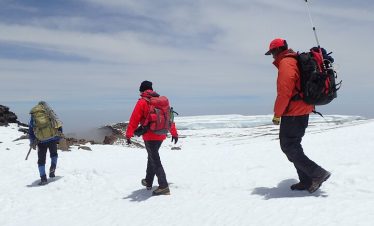
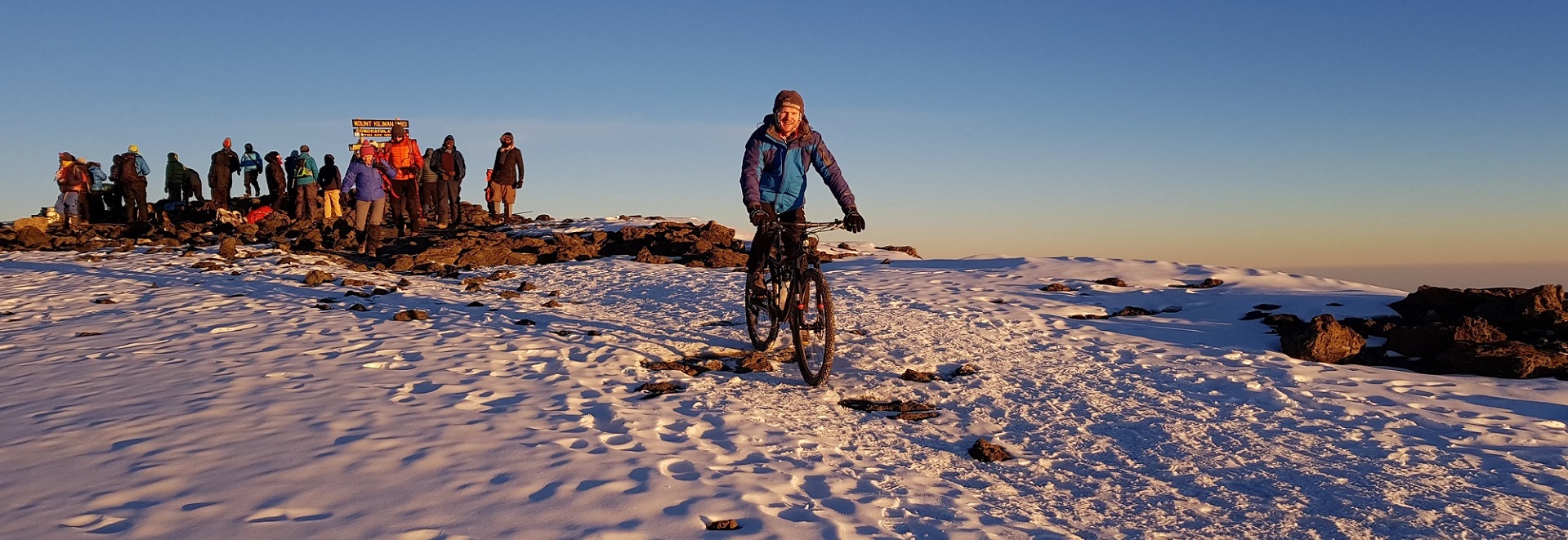
From Gillman’s Point the trail can be cycled again and you will normally encounter snow all the way up to Uhuru peak (5895m), the highest point in Africa. Depending on snowfall, mountain bikers with high fitness levels and expert technical mountain biking skills, will be able to cycle most of the trail from Gillman’s Point to Uhuru peak.
Total exhilaration and satisfaction – you made it. Weather conditions on the summit will determine how long you will be able to spend, taking photographs, before the 3 hour descent back to Kibo hut.
Again, mountain bikers with expert technical cycling skills, should be able to cycle from Uhuru peak to Gillmans’ point. It is impossible to ride the first section from Gillman’s point down to Kibo hut. Cycling will only be possible for the final 1 to 2 km before reaching Kibo hut.
Upon arrival to Kibo Hut enjoy a late breakfast and then pack your gear in your duffel bag for the porter to carry down.
Kibo hut (4730m) – Kilema gate (1950m)
Cycling time: 3 hours
Distance: 25 km.
You will then embarked on the world’s ultimate downhill mountain bike rollercoaster ride:
Starting at Kibo hut at 4730m you will descend down to the Kilema gate 1 950m – distance approximately 31km, descend approximately 3 000m in only 3 hours!
Cost
The Cost Includes
- Mountain bikes & Helmets
- All accommodation as stated in the itinerary
- All Meals (as specified in the day-by-day section)
- Drinking water on all days
- Snacks and fruits
- All Taxes / VAT
- Roundtrip airport transfer
- Support vehicle
- Camping gears such as Tents, Sleeping bags, Mattress, Tables with Chairs
- Tour guide(s), Bike Mechanic, Driver and Cook
- Village fees, WMA fees (Wildlife management Conservation Area), Cycling fee and All entry fees
- First Aid Medical Kit
The Cost Excludes
- Airfare
- Beverages and food at hotel
- Personal trekking gear
- Laundry Services
- A doctor for the group
- Tips for porters, guides, cook and assistant guides
Frequently Asked Questions (FAQs)
- The group size is between five and a maximum of ten persons
- On a private climb, you choose your hiking partners. You will not be teamed up with strangers. We can accommodate private groups of up to 200 or so.
As per the national park authorities, the minimum age for climbing Kilimanjaro is 10 years but seeing that children are more prone to altitude sickness than adults, we recommend a minimum age of 12. There is no maximum age restriction, but a medical check-up is advisable for people over the age of 65.
Kilimanjaro is one of the few mountains of its height that can be summited without mountaineering skills or experience. You should however be healthy and fit enough to manage the 4-6 hour hike each day, as well as the 12-14 hour hike on the day of the summit. For the last stretch, much endurance and willpower is needed.
Generally yes. We however discourage any attempts during the main rainy season (end of March to beginning of June). During the short rainy season (November), daily short rainfalls and cloudy views can be expected. From December until the end of February, temperatures are at their highest and rainfall is at its minimum. These are the busiest times. Between the end of June and the middle of October is also a good time to climb. Temperatures are a little lower but there is almost no rain.
Whether you actually reach the summit depends almost exclusively upon one factor: Your acclimatization. Our whole itinerary is geared towards one single day, that is to say, summit day.
A lot of the time we will have to push the bikes. Riding them would theoretically be possible but it would use far too much energy. We need to save most of this for the day of the summit…when we will have a climb of 1200m. There is more than enough time for this, as we will set off shortly after midnight. As a reward for reaching the summit we have a compulsory souvenir photo in store for you as well as a nearly 5000m descent. You’re guaranteed to be talking about this for a long time afterwards.
The Kilema Mountain bike trail runs parallel with the Marangu route. The Kilema route is mainly used as an access road by vehicles to bring supplies to the Horombo hut and to evacuate medical emergencies from Horombo hut. The route from Kilema gate to Horombo hut is a 4 x 4 gravel road, which is usually in a fair condition.
The Kilema route with first night at the Kilema camp option, is shorter, less strenuous and involves more mountain biking, compared to the Kilema route option with the first night at Mandara hut. However it is more expensive, as the first night is spend camping in tents and the rest of the nights are spend in the Marangu route’s A-frame huts.
Overnight accommodation will be in two-man tents and sleeping mats are provided. Single travellers usually share a tent with another group member of the same gender. Single tents can be provided on request at additional cost.
There are no ablution facilities except for basic long-drops (very simple latrines), but on private climbs mobile chemical toilets are included.
- Fresh water will be collected from the available sources on the mountain and is boiled before it’s served. Porters will carry water in canisters for the higher areas, where no more fresh water is available. All meals are freshly prepared by your cook.
- Meals are included as indicated in the itinerary.
- Breakfast usually consists of fruit, scrambled eggs, porridge, toast and jam, hot chocolate, coffee or tea. For lunch you are usually provided with a lunch box that contains sandwiches, boiled eggs, chicken etc.
- For dinner you will be served a soup and bread followed by the main course that either consists of red meat or poultry served with some sort of starch (chips, mashed potatoes, pasta or rice) and vegetables. For dessert you will get fresh fruit, hot chocolate, coffee or tea and milk.
- Breakfast and dinner are served in a mess tent that is equipped with a table and chairs while lunch is usually enjoyed en-route.
- We are able to provide meals for vegetarians or people with other dietary requirements or food allergies but we need to know in advance in order to cater for special requests.
Almost every hiker attempting Kilimanjaro will notice the altitude and the thinner air. Fitness fanatics are just as likely to suffer from it as couch potatoes. Symptoms include headaches that are often accompanied by fatigue, loss of appetite and nausea. More often than not, symptoms are mild, allowing you to continue to ascend. Occasionally the symptoms are more severe and a rapid descent is required, after which your body tends to recover quite quickly. Please however always keep in mind, that severe altitude sickness can be life-threatening and it may even lead to death. We do not recommend the use of medication, as it suppresses the symptoms of altitude sickness. We do however encourage you to drink enough water to replace the fluids lost from the physical activity. Two to four litres per day are recommended, as well as mineral supplements (magnesium etc.) to help replace lost minerals and to prevent muscle cramps.
- Unfortunately there are no state of the art mountain rescue services like the ones to be found in the European Alps for example. If you no longer have the ability to walk, you will either be carried or transported on a wheeled stretcher. This is by no means a pleasant experience which is why we encourage you not to overstrain your body and to travel safe. Helicopters can only land at a lower altitude and are therefore rarely used.
- Please ensure that you are covered by your health insurance while travelling. If you do not have sufficient coverage, we highly recommend taking out appropriate travel insurance. Your insurance should cover all your medical expenses including costs for rescue and repatriation.
- It is common practice to tip the members of your mountain crew after the climb. Tips make up a large portion of their income and are therefore highly appreciated. Below are some guidelines based on a group (not per person)
- Guide: 15-18 USD / day
- Assistant Guide: 12-15 USD / day
- Cook: 8-10 USD / day
- Waiter: 7-9 USD / day
- Porter: 6-7 USD / day
- Of course the above is just a guideline. If you are happy with the service received, you are welcome to show this when it comes to tipping.
- If you plan to tip in USD, please make sure the notes have been printed after 2004 as any earlier dated bank notes are not valid and can therefore not be used in Tanzania.
- Travel bag, backpack or kitbag, weighing no more than 12kg. Please do not bring a suitcase or trolley bag, as this type of luggage cannot be carried by the porters.
- Day backpack with rain protection.
- High quality sleeping bag for harsh conditions (at night temperatures can drop to -20°C).
- Different layers of clothing including thermal base layers, fleece clothing, trekking pants, warm jacket and water-resistant top layers as well as a warm headgear.
- Water-resistant and comfortable hiking boots and a variety of trekking socks.
- Please note that the above list is not complete and these are just a few things that you will have to bring with you. Once we have confirmed your booking, you will receive a more detailed list.
- Citizens of all nationalities need to contact the embassies of their travel destination to check the visa regulations.
- In general, European citizens can apply for a Tanzanian Tourism Visa upon arrival in Tanzania.
- It is the sole responsibility of every traveller to be in possession of the required documents and visa that allows them to enter their holiday destination.
- Tanzania is no longer a yellow fever region, so a yellow fever certificate isn’t generally a requirement. If visiting any other countries in the region either before or after Tanzania, be sure to check if a yellow fever vaccination is required
- Although there are no mosquitoes at high altitude, Tanzania is within a malaria region. It is up to you if you wish to take medication, but we suggest that you speak to your doctor or travel clinic about the different prophylaxis and their effects and side-effects.
- Although Tanzania does not require proof of immunization against tetanus, diphtheria, polio and hepatitis A and B, we nevertheless recommend those vaccinations.